



BlogIndustry
Order Minimums Are Dead: How Teams and Companies Actually Buy Merch
Published: Last updated:
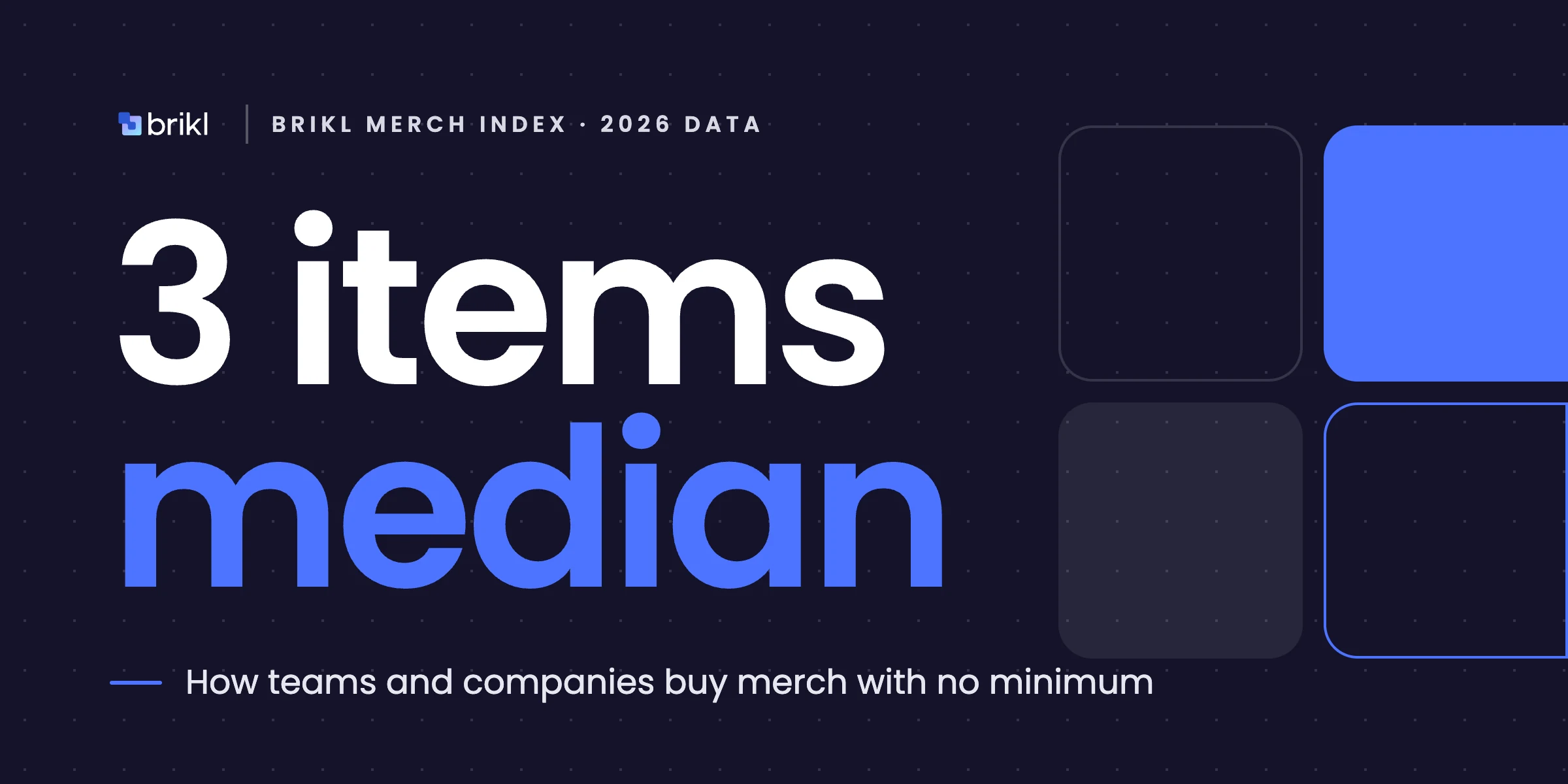
The median merch order is just 3 items. Real order data shows why minimum order quantities no longer match how people buy merch.
New 2026 data from the Brikl Merch Index
For the first time, Brikl is publishing how teams and companies actually buy merch when there is no minimum, and the answer is a few items at a time: the median order is just 3 items. Orders of fewer than 12 items make up more than half of all units ordered.
The data comes from orders placed through Brikl stores between January 2025 and November 2026, and is part of the new Brikl Merch Index. For decades, branded merchandise has been sold in boxes: 24 pieces minimum, 48 for a better price, 144 for the best one, all built around the economics of a screen-printing press. Now we can show what happens when that rule goes away, and what it means for everyone who sells or buys merch.
How many items are in a typical merch order?
| Items in the order | Share of orders |
|---|---|
| 1 item | 10.4% |
| 2–3 items | 42.0% |
| 4–5 items | 21.4% |
| 6–11 items | 18.4% |
| 12–23 items | 5.5% |
| 24–47 items | 1.1% |
| 48 items or more | 1.3% |
- The median order is 3 items.
- Almost three out of four orders (74%) have 5 items or fewer.
- Only 1.3% of orders reach 48 units, the quantity where a traditional bulk order usually starts to make sense.
In other words, the typical buyer picks two or three things they want, such as a polo and a cap, or a hoodie and a t-shirt. Only about 1 in 40 orders has 24 items or more.
Do small orders add up?
It is easy to dismiss a 3-item order. Together, these orders are the business:
- Orders with fewer than 12 items account for 54% of all units.
- Orders with fewer than 24 items account for 67% of all units.
In other words, more than half of all merch ordered through Brikl would not fit a 12-piece minimum. The demand was there, but no single buyer would have committed to a full box.
Why does the bulk-box model break down?
A minimum order quantity forces one person to buy for everyone. That person has to:
- Guess sizes for people they haven't asked. See what sizes to order for custom apparel.
- Pay up front for inventory before anyone has asked for it.
- Store and hand out boxes of shirts.
- Repeat it all for every new hire, new player or new season.
When each person orders for themselves, those problems disappear. The data shows what people do with that choice: they buy two or three things they actually want, in their own size, when they need them.
Do people mix products in one order?
Yes. Most buyers stick to one style, but 42% of orders include two or more different products in a single checkout.
Behind the scenes, those products are often made by different production partners: a polo may be embroidered in one facility while a tumbler is engraved in another. In 2026, 8.3% of orders were automatically split across two or more production partners, while the buyer saw a single checkout.
That is the real shift. The buyer sees one store and one cart; the platform handles routing, production and shipping. Removing minimums is the visible part of on-demand; read why on-demand isn't only about minimums for the automation behind it.
What does this mean for distributors and merch buyers?
For distributors, the opportunity is no longer only the big annual order. It is the steady stream of small orders from every employee, player and member, all year long. An always-on store captures demand that a minimum would have turned away.
For companies, schools and teams, it means you can offer merch without buying inventory:
- Launch a store and share the link.
- Let each person choose their product, color and size.
- Every item is made on demand and shipped direct to the buyer in 7–10 business days.
When a group does need one order for everyone, Order Builder places it on the same on-demand pricing, with no inventory to pre-buy.
Frequently asked questions
What is a minimum order quantity in merch?
The smallest number of pieces a supplier or decorator will produce in one order, often 12, 24 or 48. It comes from the setup cost of methods such as screen printing.
Can I order a single custom item?
Yes. In a Brikl store, every item is made after it is ordered, so one item is a normal order.
How big is the average merch order?
The median order is 3 items, and almost three out of four orders (74%) have 5 items or fewer.
How long does delivery take?
Orders ship direct to the buyer in 7–10 business days.
Methodology
- Source: orders placed through Brikl stores between January 2025 and November 2026.
- Units per order counts all line items in an order.
Related reading
- Brikl Merch Index
- On-demand isn't about minimums: it's about eliminating every manual touchpoint
- On-demand vs bulk: which one fits which order?
- When do people buy branded merch?
Brikl is the on-demand platform for branded merchandise, built for scale. Start free, no credit card needed, or book a demo with our team.
More from the blog
Operations
On-Demand Isn't About Minimums — It's About Eliminating Every Manual Touchpoint
The industry equates on-demand with no minimums. But the real breakthrough is end-to-end automation — and the minimum of 1 is just a byproduct.
Education
On-Demand vs Bulk: Which One Fits Which Order?
On-demand and bulk aren't rivals. They are two tools for two jobs. Here's how to tell which order belongs on which, and why you no longer have to choose a platform for it.
Industry
When Do People Buy Branded Merch? Timing Data From Real Orders
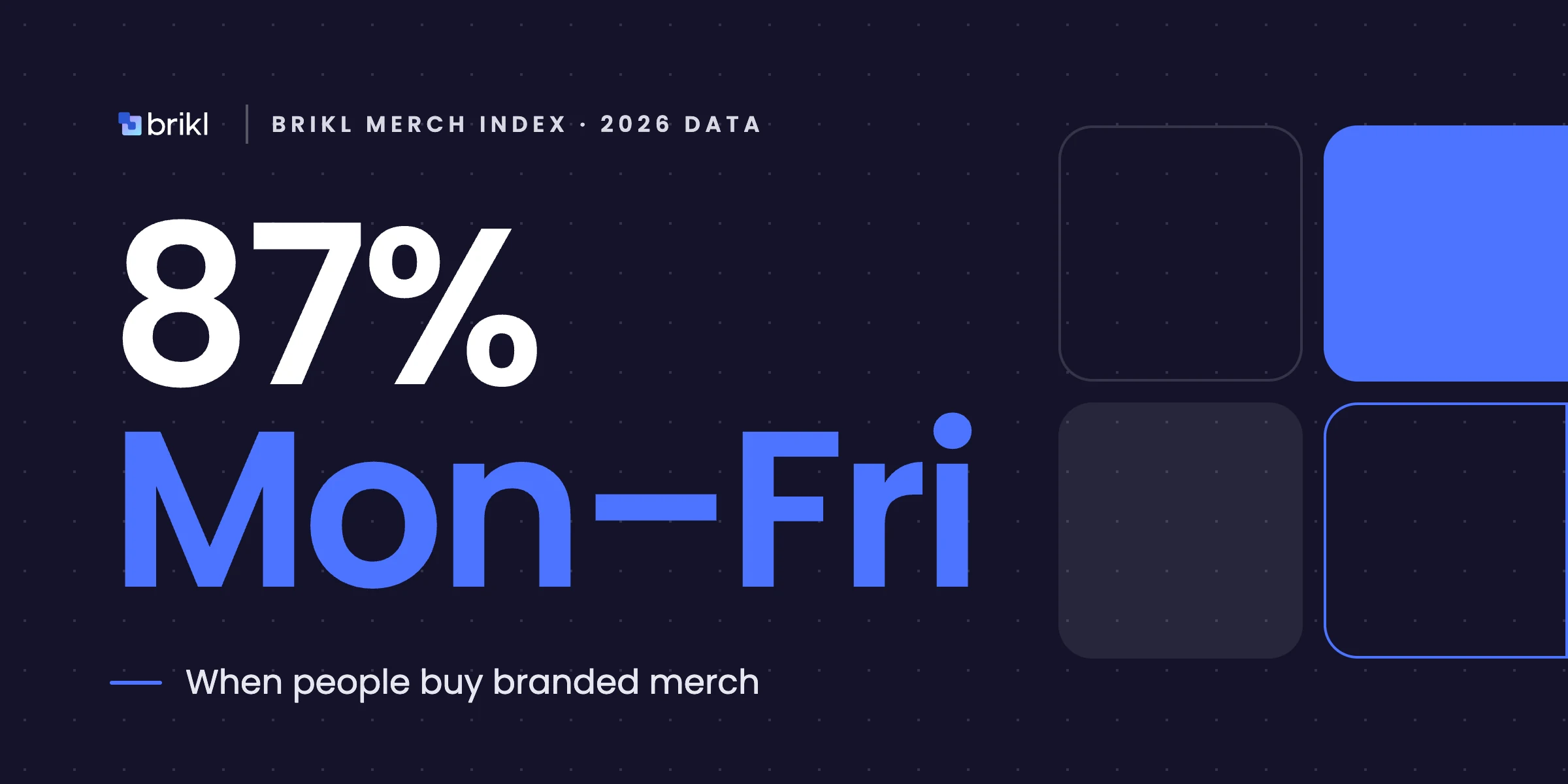
Merch sells Tuesday to Friday and peaks August to December. When to launch your company or team store, based on real orders.